TB Volunteer's Note
Designing a mobile experience to support tuberculosis case management in Myanmar


Project Overview
The product
TB Volunteer’s Note is a mobile case management app designed for Community Health Volunteers in Myanmar. The app helps volunteers monitor TB patients’ treatment adherence in their assigned villages. The collected data also supports evaluation and data management for the Myanmar National Tuberculosis Program (NTP).
The problem
Community Health Volunteers play a critical role in reducing TB infections in remote areas. However, treatment adherence is currently tracked using handwritten notes. This often leads to lost or disorganized data, making case management inefficient and limiting the ability of health authorities to evaluate interventions.
Project type
Conceptual UX case study based on real-world public health workflows
Responsibilities
Conducting interviews, paper and digital wireframing, low and high-fidelity prototyping, conducting usability studies, accounting for accessibility, iterating on designs and responsive design
The goal
Design a mobile app that: Improves TB case management for Community Health Volunteers; Strengthens data collection, reporting, and evaluation for the National TB Program
Duration:
April 2022
BACKGROUND
Myanmar is among the world’s highest TB burden countries—ranked 10th for TB and 9th for multidrug-resistant TB (MDR-TB). TB remains a leading cause of illness and death, while MDR-TB detection rates are far below estimated incidence.
Myanmar’s National Strategic Plan for TB (2021–2025) aims to:
-
Reduce TB incidence by 50% by 2025
-
End the TB epidemic by 2035
To achieve this, the National TB Program (NTP) focuses on early detection, treatment initiation, and reaching high-risk populations in hard-to-reach areas.
Active case-finding : mobile TB screening
Approximately one-third of TB cases in Myanmar remain undetected. To address this gap, the NTP conducts mobile TB screening using specialized clinics that travel to remote regions with limited healthcare access.

@ IOM (IOM’s Mobile TB Active Case Finding Bus)

@ Rafael International (TB screening)
Active case management : Community Health Volunteers
Many community members in remote areas of Myanmar have limited awareness of tuberculosis, inadequate health-seeking behavior, and very restricted access to healthcare services. Once diagnosed, patients are required to make regular trips to health centers to collect medication, which often leads to poor treatment adherence and high rates of loss to follow-up.
To address these challenges, the National TB Program engages Community Health Volunteers to provide community-based TB prevention, diagnosis, treatment, and care in close collaboration with township health staff. Volunteers visit households to educate families about TB prevention, identify individuals with symptoms, and screen close contacts for presumptive TB. They also play a critical role in supporting patients throughout their treatment journey by providing initial counseling, observing daily medication intake, monitoring side effects, and encouraging patients to attend outpatient appointments and follow-up tests.

@ WHO (Treatment support session by CHV)
UNDERSTANDING THE USER
User Research
After conducting secondary research on TB prevention and care in Myanmar, I interviewed stakeholders involved in mobile TB case-finding activities, including a project coordinator working at an NGO and a data assistant from a mobile TB screening team. These interviews revealed consistent concerns about the lack of accurate and comprehensive treatment adherence data. Volunteers currently rely on handwritten records, which are often incomplete, difficult to organize, and challenging to share with health staff.
The research also showed that while volunteers face time and energy constraints, they are open and motivated to improve their monitoring practices if provided with an easy-to-use digital tool. These insights guided the design focus toward simplifying daily case management workflows while improving data quality for program evaluation.
User Persona

PRIMARY
Name: Daw Tine Htay
Age: 21
Occupation:
college student
Daw Tine Htay is studying public health in college and working as community health volunteer for the government tuberculosis case management. She enjoys the volunteering activity, but monitoring treatment of dozens of people at a time is not easy because there is limited time and energy to trace the treatment adherence every day.
Problem statement:
Daw Tin Htay needs to have an efficient way of keeping track of patients’ treatment process and communicate with health workers because until now every information is gathered in handwritten notes and it is very slow and inconvenient to send it to the health workers.

SECONDARY
Name: Khine Yee Tint
Age: 30
Occupation:
data assistant
Khine Yee Tint is working for Yangon Tuberculosis Center. She assists collecting the data including demographic and medical information about people in the mobile TB screening. Then her team hands over the information to regional or township health staff so that they conduct case management working with the community health volunteers.
Problem statement:
Khine Yee Tint needs to get accurate and sufficient data of treatment adherence of TB patients from the health volunteers who undertake comminity-based monitoring because it helps to gain insights of the intervention and improve the current activities
STARTING THE DESIGN
Wireframes
After ideating and drafting some paper wireframes, I created the initial designs for the TB Volunteer’s Note app. These designs focused on managing information of TB patients to help the volunteers to monitor their treatment adherence.

Easy to check the week’s appointments with patients
This medication adherence chart makes it fast and easy to overview the daily medicine intake of all the patients
Low-fidelity Prototype
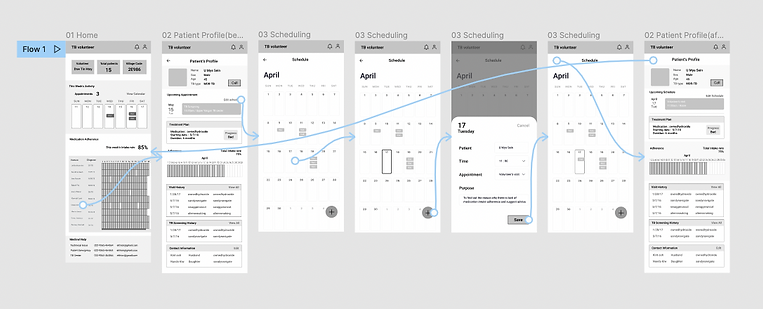
To prepare for usability testing, I created a low-fidelity prototype that connected the user flow of checking the medication adherence and make an appointment for visit to the patient with the lowest frequency of medicine intake.
REFINING THE DESIGN
Usability Test
Key insights from usability studies:
Today’s agenda
Users want to see their daily schedule immediately upon opening the app.
Add graph
Users need a clear visual overview of treatment progress.
Reminder
Users want the ability to send reminders to patients via message or phone call.
Mockups
Change # 1
Showing agenda
Based on the insights from the usability studies, I applied design changes like showing today’s agenda in the main section of the home screen as well as the total adherence rate.
Before Testing

After Testing

Change # 2
Sending reminder & Indicating progress
Additional design changes included adding a feature of sending message to allow users to send a reminder of appointments to patients, and providing a clearer indication of the treatment progress.
Before Testing

After Testing




High-fidelity Prototype
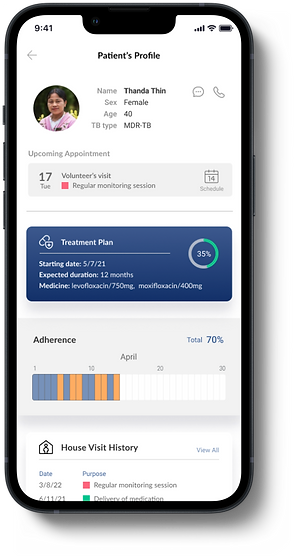
The high-fidelity prototype incorporated all usability improvements while maintaining the original user flow tested in the low-fidelity version.

GOING FOWARD
Takeaways
Geographical distance and language barriers limited user research and usability testing. Despite these challenges, the project demonstrated the value of a structured design process. Breaking down a complex public health problem into specific user needs helped guide meaningful design decisions.
Next Step
With the opportunity to collaborate with development organizations or government agencies, I would:
-
Conduct longitudinal studies to evaluate real-world adoption
-
Measure improvements in treatment adherence
-
Refine the app to further strengthen volunteers’ case management skills